 Physical security in Latin America is at a crossroads. As the wonderful horizon of IP technologies (cameras, access control systems, etc.) approaches, it seems that the road in front of us is less luminous than what we had been told.
Ethernet, that is, the default communication standard of IP technology, covers a maximum distance of just 100 meters. The traditional solution to this problem, fiber optics, can be very expensive (or complicated) in terms of implementation and maintenance.
What many of us didn't know, however, is that there is a new solution to Ethernet's restricted distance coverage, called Ethernet extenders. With the extenders it is not necessary to install optical fiber and at the same time the usefulness of copper cabling (coaxial cable, Cat-3/5/6, among others) that already runs through Latin American facilities is prolonged.
Ethernet distance limit: a new problem
The industry's migration to IP technologies is understandable, but it creates a major problem for physical security integrators. Convergence to the digital world promises the acquisition of numerous competencies and functionalities—most of which end users have been eagerly craving—but it also requires veteran integrators to venture into the Ethernet networking business. Normally, this would not be a problem, since basic network connections and IP solutions seem quite intuitive. However, a big and unprecedented problem arises when physical security integrators must protect an extensive perimeter or implement IP solutions at very distant points:
Unlike the long distances covered by analog technology, the distance limit of Ethernet transmission is only 100 meters. So what should integrators do?
Naturally, some of our colleagues, who have more resources, have researched computer networks and started to implement fibre optic connections, but this is not always a viable solution.
Migrating to fiber optics may not be an ideal alternative in Latin America
While it is true that Latin America is rapidly adopting fiber optics for its basic Internet infrastructure, major distribution centers and FTTH, when it comes to deployments between and within private facilities, security integrators and end users have had doubts about whether or not to migrate to fiber optics. This is mainly because such a transition requires specialized knowledge, that its implementation can be expensive and that its repair can generate very high costs. Not everyone in Latin America is a huge telecommunications company that can afford to make this leap. Even worse, even if we could, many of the latest IP cameras from Axis, Honeywell, and other companies, work through PoE (power over Ethernet), but fiber optics (i.e., lasers) cannot transmit electric current.
Fortunately, it turns out that we don't have to make the leap...
Now you can leverage your existing copper infrastructure (e.g., coaxial cable) to transmit data and power over long distances.
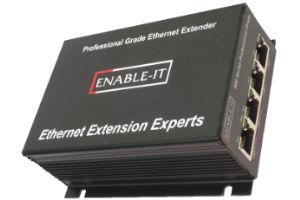
Ethernet extenders are low-cost devices that allow you to use the abundant copper infrastructure you already have (e.g., coaxial, certified, twisted pair cable) to send data over a distance of up to 1.83 km. And all this without links in between. In addition, Ethernet extenders can send data and PoE power over a distance of up to 1.06 km, also without links.
Ethernet extenders only cost a few hundred dollars per kit and are very easy to install in applications over long distances. You just have to connect your network to one of the extenders in your kit, then connect your long-distance copper cable (coaxial cable, Cat-3/5/5, etc.) from the interconnect port of that extender to the interconnect port of its corresponding extender. Finally, simply connect your IP device (e.g. camera, access control unit, or perimeter security sensor) to one of the remaining LAN ports on your extender.
You don't need to outsource fiber optic installers, and better yet, you'll be able to extend the value of your existing infrastructure. There is no need to migrate to fiber optics to provide physical security over long distances.
A challenge for Latin American integrators: forget about fiber
Ethernet extenders for Latin America come at a very opportune time. While much of the industry is rushing to IP solutions, few have thought about how this transition could affect integrations over long distances in regions where fiber optic cable installation is not always feasible. Now, those who really have to think about these matters, do not have to: Ethernet extenders skillfully overcome the distance limitations of Ethernet and allow you to concentrate on integration.
Knowing the option of Ethernet extenders allows you to have a strategic advantage over those integrators who do not know it. The question is, when the time comes for your next integration over long distances, will you remember to forget about fiber optics?