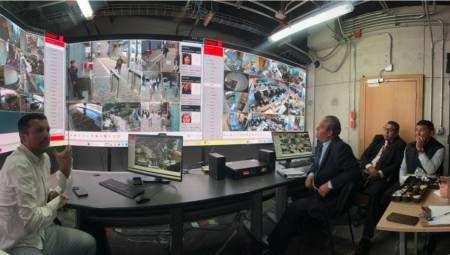

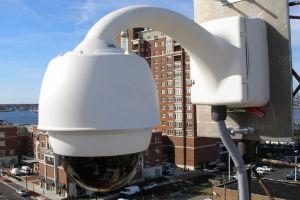
 Megapixel equipment, IP transmission and good lighting conditions, are some of the factors that influence to provide good citizen video surveillance and remain over the years.
by Ana María Restrepo Franco*
When talking about surveillance, we immediately think of cameras that allow the monitoring of some areas and movements that call for the deployment of a police force prepared to deal with these situations, and this is not far from reality, but that security will not be efficient if you do not have a good video surveillance system that meets the needs of the locality.
Diagonals in quadrants, intersections, traffic lights and corners are the main sites where the equipment is installed, since from these points you can get a view of the area, but as Manuel Hernández, vice president of sales for the Andean region of LRG Int. says, it is necessary to locate the cameras in such a way that when you look towards one point you do not neglect another. This postulate is reinforced by María Fernanda Barragán, business director of territory - Andean region of Bolide, who comments that there are certain rules that say that a camera should not be installed beyond every 30 - 40 meters.
"In urban surveillance it is essential to have a total vision of the area to be protected, it is useless to be looking to the right, if I am not observing the left," says Manuel.
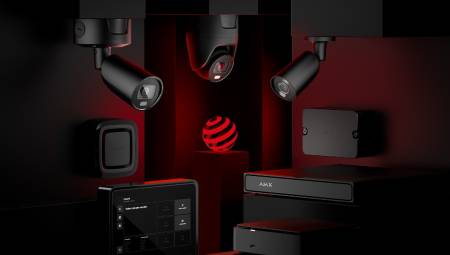
The dome cameras, which have 360° horizontal movements and approximately 200 vertical and PTZ (Palt, Tilt, Zoom), are ideal for this type of installation, since their rotation allows you to observe all areas, see the details and approach targets, suspects or vehicle licenses.
However, Luis Alberto Delgado, regional sales manager of Axis Communications for South America – Northern Cone, explains that this system should be supported by fixed cameras because they allow monitoring 24 hours the same areas, since the domes have a lot of versatility to have details but being looking in the same direction is neglecting the rest of the area. Knowing this, what should be done then is to have a mixture of motion cameras and fixed cameras to achieve better results and not neglect any area.
Hernández reinforces what Delgado said, assuring that the important thing is to have equipment in strategic places that allow to have control of the monitoring, of the whole context in order to know the precise information of a particular point or to follow up having redundancy, for example in a next corner, or in the next crossing, this allows to determine the actions of the target, what is the direction, the speed or where it is located.
"For roads and traffic surveillance it is advisable to use pole-point cameras with an optic (zoom) of around 30-37x, which is integrated into a positioning system. For the interiors of the city, the ideal is to have cameras installed with a maximum installation height of 15-20 meters and for the transmission of the video, it is advisable to have IP, "says Alex F. Pazos, director of engineering application for Latin America of Samsung Techwin.
It is also advisable to have equipment that is installed at intersections or at points a little lower than normal, such as bridges, which serve to look up, and make it possible to see from a lower point, looking towards the top and have other perspectives and a guarded point.
Ideally, these cameras provide a reliable system with high resolution, which is the specific requirement when we talk about citizen security, so the idea is that they are megapixels and have video analytics.
Image quality and brightness
Being megapixels will provide better resolution and, of course, sharper images, but, as Manuel says, these cameras will need greater luminosity to work: the more pixels a camera has, the more light is needed. The drawback is that countries do not have a uniform, permanent and constant light 24 hours a day, because companies offer 12-hour lighting services and not 24 hours. The ideal is then to have an additional light element that complements the system, either white light or infrared light, the latter is ideal to be used in places where the camera is directed towards vehicles or people since it does not dazzle them.
It should be noted that to operate during the day, the cameras must have the feature of extended dynamic range because they are cameras that are facing strong lighting conditions, strong contrasts or even the lights of the vehicles can interfere and for this reason it must have HLC compensation, to balance those direct lights and dynamic range for backlight issues. In an urban security system it would be good to add audio capture in the areas of influence of the cameras helps to clarify real situations. Remote reaction systems such as loudspeakers and high-intensity lights, save patrol movements and serve as a deterrent to crime.
However, it is necessary, as stated by Germán Cortés, manager of Insetron Ltda and Senior Technical Consultant, that the security system uses all existing electronic security equipment, that is, once the corresponding risk analyses are carried out in each area, they must be mitigated taking into account the concept of detection rings, verification and reaction, using communal alarm systems, perimeter detection, identification systems, access control and obviously the verification stage through a video system.
"Many times when you think of a citizen city, you only take into account the video system, ignoring the other technologies and wasting the concept of integration and automation, so that it really becomes a tool of the patrol."
Monitoring and transmission of information
The current trend is the migration to IP, and to be in force within 13 years (2025) the ideal is to have IP monitoring and platforms with open protocols that allow the integration of different equipment and programs so that everything is managed from the same platform and delivers the possibility of using security systems from different manufacturers, creating a robust platform that allows updating and its technological growth.
The recording of the images must be decentralized to be found in any data center, but it is important to note that citizen surveillance images are used more for statistical data and review of some facts if required.
"The best way to record the images is how they are generated in the camera or digitized inside the digital recorder, without significant alterations that compromise their quality. Therefore the recording must be made at the maximum original resolution of the cameras, at the maximum speed (at least 24 FPS) of refreshment to preserve a good dynamic resolution and with the due digital authentications that allow at the forensic level to give credibility on the images, "says Germán.
As for the transmission of information, fiber optics is essential due to the bandwidth required for high-quality transfer, it is a medium of high security, reliability, speed and that remains in force before the passage of various technologies. However, this means implies high costs, so some experts recommend a partnership between the public and private sector to optimize the use of fiber, using it for the transmission of the urban surveillance system and for the provision of high-speed broadband internet services. For his part, Luis Alberto believes that due to the high costs and risks involved in wireless transmission, the citizen security system must have a mixture between the ring, fiber optics and wireless links.
Future surveillance
It is difficult to predict what will happen in 13 years, especially in a market that is constantly changing and evolving, the important thing is to have equipment and systems that are scalable and allow modifications and additions.
For Manuel Hernández the ideal is to have megapixel cameras with video analytics and fiber optic transmission, and although it is known that these technologies will continue to grow and improve more and more, they will allow the adaptation of new equipment, as long as there is a platform with open architecture, a good distribution of devices and personnel, since the human factor within this protection system is very important, because action without reaction will never be efficient, you can have a better system of action but it will always be inefficient.
Germán believes that the cameras will continue to advance in resolution, lowering their cost and decreasing in size and the massification of fiber optics will decrease investments. Developments in detectors at the three-dimensional level and identification of small parts will also be another important factor.
For his part, Alex Pazos believes that all the technology in the security industry is making the transition to IP technology and for more than five years of effort it is already reaching the point of very stable and robust products such as analog products. Cloud storage is also one of the technologies that will grow and will be widely implemented in the coming years, as the internet provides flexibility for recording and remote viewing anywhere in the world.
Citizen protection demands responsibility, compliance and, above all, commitment, it is essential to have intelligent systems that give constant and continuous coverage of an entire locality, providing greater security to those insecure areas and strengthening safe ones in order to achieve greater control of illicit activities, but for this it is necessary that the government invests in high-tech equipment, that help reduce the rate of violence. All this, despite the high costs and investments, will result in a decrease in crime.
* This article was written by Ana María Restrepo, editor-in-chief of the magazine Ventas de Seguridad, with the collaboration of María Fernanda Barragán, business director of territory - Andean region of Bolide; Manuel Hernández, vice president of sales for the Andean region of LRG Int; Luis Alberto Delgado, regional sales manager of Axis Communications for South America – Northern Cone, Alex F. Pazos, director of engineering application for Latin America at Samsung Techwin; and Germán Cortés, manager of Insetron Ltda and Senior Technical Consultant.