 In this second installment of the projects in electronic security we will develop in firm all the theory of project management, which is based on the good practices for project management, developed by the PMI®.
by Henry Rivera*
To begin with, the process matrix developed by the PMI® is presented, which is composed of the five management processes and nine areas of knowledge, each of which are integrated and develop a series of threads for each of the components of the matrix.
This matrix is presented below and throughout this delivery the managerial processes will be developed, the areas of knowledge that are involved for the formation of the subprocesses, in such a way that it is clear how the management of this matrix is and what it represents.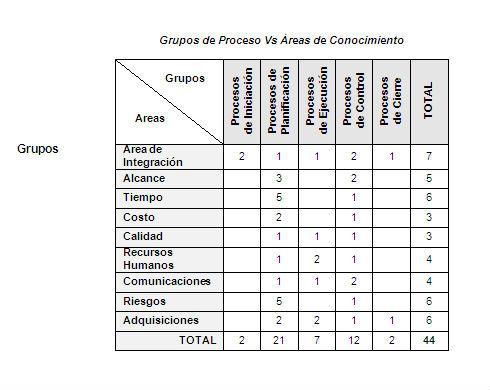
The managerial processes and areas of knowledge that are developed for good project management are contemplated in a matrix that the PMI® has developed in its book PMBOK 2008, which can be taken as a reference to deepen knowledge in project management. The numbers found in each quadrant identify the number of threads that are generated by each area of knowledge in a given management process.
Five processes
Initiation: In these processes all those faces for the authorization of the project are related. It consists of a total of two subprocesses and as a result of this the project letter is obtained, the one where the project manager is authorized for its development, and the scope statement, which shows how far it goes and low limitations which the project will be developed. These developed elements can be located in the first quadrant of the matrix.
Planning: These are developed in order to refine the idea of the project and its objectives. To fulfill this task, the project manager generates a Project Management Plan, which contains the different purposes of the areas of knowledge in order to be able to develop the plan in an appropriate way. Below we will list the different elements that are developed in each of the areas of knowledge to form the management plan:
- Integration: Develops the general project of the Project Management and integrates all the developed plans that are presented below.
- Scope: Planning and definition of the scope, with the purpose of developing the Work Breakdown Structure (WBS), work breakdown structure; this is very important because it determines which are the main deliverable components of a project.
- Time: The activities, their sequence of development, the resources for their progress and their duration are defined. All in order to get the work schedule for the project.
- Cost: The values of the project are estimated and from this the budget of the same is developed.
- Quality: A plan is developed to guarantee, how they will be and what are the standards that will be handled to determine the quality of the project.
- Human Resources: It is planned how the recruitment of the personnel who will work on the project will be and how its administration will be, until the disengagement.
- Communications: A plan is defined in which the different ways in which the reports that are developed for the progress of the project will be presented are proposed.
- Risk: This is one of the most important plans to develop. If we have a clear procedure for the early identification of risks, quantification and qualification, as well as their possible management or response, we will avoid having inconveniences in the development of the project in its execution stage.
- Procurement: A plan is developed in which a series of initial proposals will be requested from each of the suppliers according to the requirements of the project and the evaluation of the proposals presented.
Execution: These processes are made up of seven subprocesses and are responsible for the development of the project. The areas of knowledge that are linked to this managerial process are:
- Integration: The development of the project is developed in a unique way in such a way that the developed plans are fulfilled.
- Quality: The quality assurance plan for the project is carried out, in such a way that it meets the client's expectations.
- Human Resources: At this time we begin to recruit the entire team that will be linked to the project to proceed to develop it.
- Communications: It begins with the presentation of reports to the different stakeholders of the project, in such a way that the established communications plan is complied with.
- Procurement: A prior request for proposals is made, in such a way that they are evaluated and gives rise to the selection of the supplier or suppliers that will be in the development of the project.
Control: These processes are defined as those where the progress of the project is controlled, in such a way that it is identified if the plan that is drawn up for it has been varied, in this way the corrective actions of the case are taken. It has twelve sub-processes that are developed in the following areas of knowledge.
- Integration: An information survey is carried out, through reports, in order to measure performance and make changes that improve processes.
- Scope: The changes that have been presented in the scope are controlled and in turn it is verified that portion of the project has been executed.
- Time: It is verified in what percentage the established schedule for the project has been met and how much additional time is required to finish it.
- Cost: It is one of the most delicate areas of knowledge, because it reflects all kinds of variation of the project. Here a control of the executed budget is carried out and additional costs have been incurred.
- Quality: It is controlled that the project is being developed with the standards and those aspects that may affect the performance are identified in order to eliminate them.
- Human Resources: The work team is monitored to determine problems that can be solved and thus guarantee a better performance of the work group.
- Communications: This is another of the important points to develop within the control, since it is responsible for verifying that the interested parties are sufficiently informed of the progress or changes of the project.
- Risks: It is controlled how the monitoring of the risks has been, if there are new ones and if the plans have been effective or not.
- Procurement: The monitoring of each of the contracts, the performance of the suppliers and, if applicable, the failures detected is developed; corrective measures have been taken or will be taken with them are analyzed.
Closure: These processes constitute the definitive closure of the project and will only be executed until the project product, also called the main deliverable, is accepted.
- Integration: At this point the project is definitively closed. All the documentation required to close in a formal way is delivered. In this process, delivery records and other elements required to settle the contract are developed.
- Procurement: In this process, those contracts that are held with suppliers or contractors are liquidated in such a way that the project can be closed in the economic aspect.
Well as I see this theoretical part of project management is quite dense, but it is important to have clarity of what are the steps to have a good development of a project. Secondly, this matrix presents us with a key, fundamental in the development of projects, which is based on good planning.
Calve 3: The success in the development of a project is based on its detailed planning, because as can be seen in the matrix of Processes Vs. Areas of Knowledge, the process that has the most subprocesses is that of Planning, which makes me dare to mention this phrase: "Do not worry, do it, start now! and along the way we look to see what is done", but the reality is different, it is necessary to plan well, take the time required to make the execution of the project easier and do not lead to mistakes, which usually always end up making the projects more expensive than normal. And if we look at execution it has fewer processes than planning, to the point of stating that planning threads triple execution threads.
Calve 4: As you can see the success of the project is based on planning, this triumph in the projects has an important aspect in the control process because it would not help us to plan very well if we do not control what we capture as a plan, we will never have an evaluation of how the project is Vs. the state in which it should be, both in scope, time and cost.
Calve 5: For a good development of a work schedule requires seven very simple steps, which when implemented can be applied to feed data into computer tools for planning, monitoring and control of projects.
These steps to follow are as follows:
1. List each of the partial deliverables of the project, that is, which by-products make up the product of the project.
2. Then the activities that have to be developed to elaborate this by-product are recorded.
3. The logical sequence is established to develop the activities to generate the deliverable or by-product
4. The different resources that are required for the development of the deliverable are allocated, these can be human or material.
5. A prudent period is determined for the development of each activity, in such a way that a time limit can be had for the delivery of the element to be developed.
6. Costs are allocated for the development of the deliverable.
7. Finally, the schedule for the development of the project is obtained.
The development of these steps will guarantee us to have a plan to control the time, cost and scope of the project, which is called in projects as timelines and cost.
Continuation of the analysis of the case
As it is the objective of each delivery is to apply it more prominent of the project management in electronic security applications, for this article we will analyze how a schedule would be generated for the installation of the CCTV of our hypothetical case. In it, the installation of the mobile dome-type camera will be developed.
1. Partial deliverable list: A mobile dome camera.
2. List the activities to develop the deliverable: Install gutters from the control room to the camera point, place camera, force wiring, data and video, place support, perform tests, splice cables and connect.
3. Logical sequence to develop the activities: First the measurements of the gutter are taken installed, then the gutter is installed, the wiring is located inside the gutter, the gutter is closed, the force wiring is spliced, then the video and data cable, the camera support is installed, the camera is installed, it is connected and finally the camera is tested.
4. Allocation of resources to the activities: For the installation of the gutter two (2) technical auxiliaries will be used, for the wiring one (1) technical assistant will be used, the support requires two (2), for the joints one (1) electronic technician is required and for the installation of the camera and its respective tests one (1) technician. At the same time, 50 meters of gutter, 65 meters of coaxial mable, UTP and power supply are needed, 1 mobile dome-type camera with its support, transformer and protection elements.
5. Allocation of time to activities: The installation of the gutters can take 2 days, each day of 8 hours with the two required resources. The assigned resource can take 1 day of 8 hours to place the wiring and the installation of the support can take about 3 hours with the same resource. The realization of the joints can be done in 2 hours with the required personnel, and the installation of the camera and its tests would take 2 hours and 1 hour respectively.
6. Allocation of costs to resources: the hourly value of the technical assistants is on average US$ 4 per hour, of the technician is about US $ 8 per hour, The linear meter of the gutter has a value of US $ 1, the coaxial cable of US $ 95 cents, the UTP on US $ 75 cents and the power supply on US $ 65 cents.
7. Development of the schedule: Finally by feeding the computer tool that for this case would be MS Project, it will throw us the time it will take to install the dome type camera and the cost of this partial deliverable. We will call this schedule a time and cost baseline; on this, the controls will be developed to the progress of the project in relation to the installation of the dome camera.
*Henry Rivera is the manager of Centinel Seguridad.