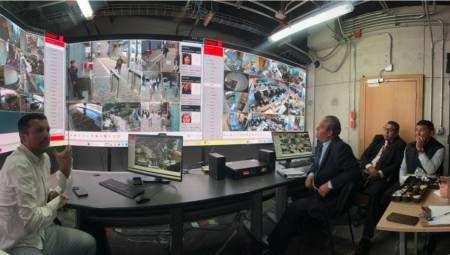
Historically, security operations centers were largely hidden deep in buildings, in basements or back rooms where they could never, or rarely, be seen by the public. Because of this, the design approach to the security console was most of the time a function and very rarely a form. Rarely were consoles a pretty thing; no importance was given to the appearance of these as long as they were functional, in addition to having the necessary equipment to perform the proposed work.
"Since 9/11, as security has transitioned from a new idea to a primary government concern, corporations and the general public also have it over security operations. In an effort to increase our well-being and sense of security, organizations are increasingly choosing to run security operations on their extremely visible facilities. As a result, the approach to safety consoles in the technical furniture industry is changing and they take into account aesthetic considerations," says Wayne Cook, sales director of The Winsted Corporation, designers and manufacturers of technical furniture.
Creations for safety
Fortunately, changes and evolutions in security technologies are helping this aesthetic component. Advances such as the emergence of digital technology and the integration of flat panel monitors have allowed designers to create attractive security consoles with compact presentation designs.
For example, new digital video recorders (DVRs) quickly replace their annoying analog predecessors for use with CCTV surveillance systems. These digital devices are currently smaller and use less space inside the console. In most cases, they are even completely removed from the console. Digital archive servers allow console operators, from their seat, to have real-time access to or archive information, even if the electronic part is located behind the scenes in the equipment room.
As an added benefit, shifting the heat that produces more electronics out of the main safety console and on secured, individual vertical shelves, in temperature-controlled equipment rooms, means less heat is produced inside the safety console. This arrangement alone entails aesthetically pleasing and ergonomic consoles and greater comfort for all security personnel, 24 hours a day, seven days a week.
Industry Input
Advances in security system integration are also contributing to a smaller console design. The days are numbered when you had numerous large CRT monitors to view simultaneously, and soon they will be just part of the memory. Also many different aspects of a system can communicate with each other. For example, access door controls are linked to cameras, which are linked to multiple surveillance controls; as a result, operators are paying greater attention to information in relation to current security situations.
Currently, operators can install cameras that send signals to electronic switches when one of the cameras detects motion, or install access control and door panels to turn on particular cameras and display images on monitoring screens, if used at inappropriate times.
As security systems become smarter, console operators require fewer control elements within the console. Security consoles have become part of the IT infrastructure that enables interoperability and integrates access control, CCTV, biometric security, lighting, alarm systems and fire systems.
Ergonomic standards
Ergonomics and anthropometry, worker studies and their relationships to the console environment and body measurements, are an important factor in new console designs. Ergonomic standards have been revised to consider these new technologies, including an understanding of anthropometry and our bodies (heads, necks, eye movement and posture) interacting with this work environment.
The previous standards of consoles that were stopped in the sixties, were based on ergonomic studies performed with the posture of a person in a "sitting position", with their hips, shoulders and ears in a perfect straight line. Actually, no one sits in such an awkward position, especially for a time in shifts as long as eight to twelve hours.
With this understanding, the new ergonomic standards are based on more realistic assessments of how operators work on desks and in security control and command consoles.
"By nature, we are hunters and gatherers. Common sense tells us that when hunting, we look straight ahead so that our eyes can explore the horizon. When we gather, our eyes focus downward in front of us in close proximity," Cook says. "No matter what our modern occupations and tasks are, these fundamental truths have not changed."
According to Cook, "Recent ergonomic studies show humans sitting in a 'relaxed position' with our heads tilting approximately between 8 and 15 degrees, eyes looking at minus 30 – 35 degrees down to achieve proper viewing and an average viewing distance of 30 inches from monitor screens. With this in mind, the new console designs have a lower target angle for displaying all primary monitors."
Touchscreen technology is also starting to affect the ergonomics of new console designs, especially in high-security, high-attention environments. Case studies show that when people get extremely nervous under high-stress situations, they have problems with computer mouse operation and activating emergency icons, all adding to delays in response times.
Studies also show that people have fewer problems pointing their finger at touch screens to increase accuracy and achieve faster response times. As a result, touch screens are becoming more and more common in high-security, high-stress applications.
Consoles that incorporate touchscreen technology have shorter distances between the operator and the monitor screen, so operators can comfortably touch the screens while sitting in a "relaxed position".
With these changing trends happening concurrently, technical furniture manufacturers are able to rise to the challenge and react quickly to create new safety consoles that are ergonomic, aesthetically pleasurable and functionally superior.
Several of the low-profile System/85 and Prestige Slim-Line console systems are designed in such a way that the operator's focused viewing angles are appropriate with respect to all monitors and electronics. You also have the ability to incorporate large plasma and liquid crystal monitors, rear projection screens or video projector systems in front of low-profile consoles over the walls of the security room.
Of course, solutions vary from one security center to another, both in form and function. A security office within a campus, a retail store or a corporate facility will be significantly different from a government security operations office or a control center of a power plant, all have different demands, from the number of cameras, electronic equipment and operators of each of the consoles to the different material requirements and this ticos.
"The ability to offer the widest range of product offerings is great," says Cook. "Winsted specializes in modular and custom-made technical furniture for the security industry. We offer a wide variety of product families with more than 1,500 off-shelf models or we can design exactly whatever is needed for virtually any application."
Design for the crisis
Most often, safety operations centers are designed for the daily procedures of normal operation. They include just enough consoles to accommodate operators in such work routines and a little more. When updating or creating a new environment, crisis situations for command and/or control security centers should be considered.
In most of today's environments, when a crisis arises, security and emergency service personnel, management, and perhaps government officials, find themselves suddenly cornered inside a tiny security room; analyze incoming information on small consoles and screens. It is an impossible situation to take quick action and effectively handle a security incident.
We now know that crisis situations are not always imagined scenarios created for the sole purpose of training security personnel from the safe world we once knew, we need to be prepared for times of crisis. No matter what type of security installation you own, the facilities will grow and security will not be simpler; it is becoming increasingly complex. Even the normal operating procedures have changed.
We see a growing number of surveillance cameras, limitations for access and the integration of all security systems within a facility that is being visualized as the most important investment of our time.
Security consoles, operation centers, and command and control environments must be designed to handle these changes. Design for crisis, a hope for routine.