 What are the main developments that hybrid safety systems have presented? What is expected for 2011 in terms of technology and what benefits will this bring to the end user? Learn from industry experts these and others by minors of the subject.
By Santiago Jaramillo H.
From the perspective of Fernando Barrientos, regional sales manager of the Surveon company, three fields are presented in which the hybrid concept is developed: Management of cameras of different technology (IP and Analog), customer management of VMS (CMS and NVR stations or PCs) and Storage Management (NVRs, PCs and RAID storage devices with SAS or iSCSI connection).
In all these cases, according to Barrientos, an interesting development is expected especially in hybrid camera solutions (there is a very large liability of analog cameras in many of the video surveillance users who need to update their systems) and storage (the growth of megapixel cameras involves larger storage solutions, and these in turn the development of more efficient interconnection technologies between DAS, iSCSI or Fiber).
"The user is pleasantly benefited in terms of, first of all, cheaper 'solution costs', as well as in flexibility and speed of implementation when it comes to having more technological resources to implement an application," says the regional sales manager of the company Surveon.
For his part, Alexánder Gutiérrez, sales manager for the Andean Region of GVI Security, believes that first we would have to understand what he means by hybrid system.
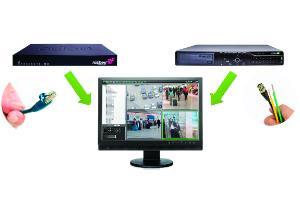
"It is usually known in CCTV as the system that is capable of handling both IP and analog devices on the same platform, the most common being Hybrid DVRs (HVR or HDVR). A second way is to use NVRs and add single- or multi-channel IP encoder devices (encoders) to analog cameras. It is also widely used to integrate into the software platform (VMS) the devices that connect analog cameras (encoders and DVRs) with IP cameras, in such a way that for the user it is transparent if he is watching video from an analog camera or an IP, "he emphasizes.
For his part, Antonio Pérez, sales manager for the Caribbean, Central and South America of the company Network Video Technologies (NVT), affirms that "hybrid systems have been developed in all areas of the industry. Perhaps in the field of Video Surveillance is where it is most evident. From the camera to the VCR. And of course, in video transmission systems that take advantage of UTP structured cabling. The big benefit for the end user is getting the best of both worlds, analog and IP. And what these hybrid transmission systems guarantee, in addition, is a simple transition, adaptable to the technological and economic capabilities of each end user."
Using the system
Regarding the issue of which are the sectors that most use hybrid security system services, which are beginning to use them and which do not yet show interest in implementing them, Antonio Pérez indicates that practically all sectors are already adopting these systems. "We've seen large-scale hybrid applications in Banking, Gaming, Hospitality, Government and Retail," he says.
Meanwhile Fernando Barrientos assures that "the interested sectors are the most diverse, from ports, hospitals, universities, banks, citizen security, factories, chain stores, restaurants, shopping malls. In general, medium and large establishments where the need for a hybrid solution represents greater savings."
Likewise, Alexánder Gutiérrez supports the previous statement by pointing out that "in our region the large users of hybrid video systems are banks and some chain stores, because they have a base of analog cameras installed relatively recently and do not want to 'lose' that investment, but they do not want to be left behind in technology and seek the ability to install an IP camera (especially megapixel) without having to change the entire system. "
It also warns that with the decrease in costs in the components of IT infrastructure and storage many users are making the "leap" of moving from analog systems to fully IP systems, without interest in using hybrid solutions.
There is a third group that is composed of users satisfied with their analog system and the cost-benefit ratio does not motivate them to make the switch to a hybrid system and less a fully IP one.
Most common mistakes
Our industry specialists also weighed in on what are the most common mistakes a customer makes when ordering a hybrid system.
Given this, the representative of GVI Security comments that "speaking of the HVRs more than customer errors, omissions occur when requesting the equipment because customers think that a hybrid DVR (HVR) will support any type of IP camera at any speed and do not see the specification of the manufacturers where it is mentioned which models and types of cameras are supported by hybrid DVRs. In most hybrid DVRs (HVRs) the number of IP cameras, speed in fps or the maximum resolution it can handle is limited."
Meanwhile, the representative of Surveon points out as one of the main problems the "not knowing well the Pros and Cons of a megapixel or analog solution, as well as network configuration. One seeks with a hybrid system the best solution for the case that in a certain circumstance the combination of various technologies or solutions is required. There are applications that best go with IP Megapixel, others with analog and others with both, "he clarifies.
For the NVT representative "perhaps the most common mistake is the opposite, not requesting a hybrid system when it is really the most convenient. The customer thinks that he must necessarily install an IP system when a hybrid system can perfectly cover their needs at a much lower cost and at the same time guaranteeing the future migration to IP at the right time, "he emphasizes.
Antonio Pérez also spoke to us about the way in which hybrid security systems can be combined with other electronic security and/or alarm systems.
"From hybrid security systems, a Scalable Architecture is adopted that allows Technological Convergence by having a cabling infrastructure and trajectories that can be used and shared by the different electronic security sub-systems under standards. A clear example of this are sub-systems such as intrusion, access, fire detection under shared management platforms and with significant savings in terms of the total cost of ownership of your investment.
Fernando Barrientos clarifies that "they can be combined through the communication of events detected by hybrid systems (which includes cameras), in such a way that electronic security systems more efficiently base their alarm actions".
In short, the hybrid solution has benefits in different aspects such as the budget, because unlike an IP solution it allows you to use the existing infrastructure (cameras, installation) and take advantage of the benefits of the IP solution for new cameras in a transparent way for the end user because the interface is the same.
As Alexánder Gutiérrez clarifies, if a client does not have any existing infrastructure, the decision (apart from costs) would be based on image quality, looking at parameters such as resolution and latency times.
"You have to understand that the IP solution is the one that will end up imposing (...) The hybrid solution is an intermediate step between DVRs and NVRs that in many cases is interesting for those customers who have an existing installation; an analysis would have to be done on cameras and wiring and compare the benefits and costs of keeping the current against investing in a fully IP solution," he concludes.