For this edition of the magazine VENTAS DE SEGURIDAD we will have a very special guest in the CPP section of the Month, Jaime Owens, a Panamanian who for 22 years has been linked to the field of security.
 By: Santiago Jaramillo H.
Jaime Owens, our CPP of the month, began his career in the world of security in the Panama Canal in February 1988, where he grew within the Protection Division to the position of Supervisor of the Protection and Surveillance Unit in the Atlantic Sector. Currently, apart from his activity in the Interoceanic Canal he is involved in the field of education, has experience as a rope facilitator and has a Franklin Covey certification.
As our guest acknowledges, his involvement in the security industry was totally circumstantial: "In 1988, while studying economics, Panama was going through one of the greatest political-economic crises. I remember a good friend, Heriberto, telling me that the Panama Canal required reliable security personnel, and he recommended me. In this way I understood the importance of security for companies, which became my career and passion."
On the other hand, and when asked what the function of a CPP is, Owens indicates that "you must know a wide range of topics related to the security of your organization, from the principles of security, best business practices, personal, physical, and computer security, to emergency management and investigations, in short, a CPP must have knowledge in risk analysis, understand vulnerabilities, know the business to be able to identify the impact, but at the same time, must demonstrate the priorities in a management language, which can identify the cost-benefit of the solutions presented, which must be consistent with the legal practices of each area. "
As for the purpose of being certified as a CPP, this representative of the Panamanian industry assures that "the answer is very simple, private security is a very complex field, having been a police or military can have an advantage in the knowledge of public security, however, private security has a different 'doctrine'. Being a CPP is being able to demonstrate advanced knowledge in security management, gain professional credibility and be far ahead of the competition, additionally, there are many people within police and military organizations who have achieved the degree of CPP, "says Owens, who warns that a CPP has the obligation to stay updated because in order to maintain this status this is evaluated every three years.
And with regard to the challenges that a CPP faces every day, Jaime Owens highlights that "the main challenge is with credibility. Stay within the code of professional responsibility, understand that things change, and what today is the solution to reduce a risk, tomorrow may not be, in short, the challenge is not to be triumphalist, is to be aware and updated all the time, foresee the threats and control of them, this applies to petty theft even for a terrorist attack, to keep our organizations running effectively and efficiently."
The perfect complement
Electronic tools are definitely an essential complement in the daily work of a CPP, as definitely evidenced by our guest, who also ponders the importance of complementing them with a good integration scheme between public and private security.
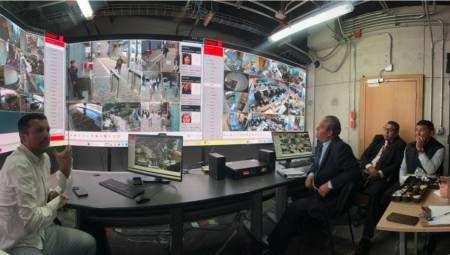
"Private and public security are not competition, they are more of a complement. To this end, law and order are the responsibility of public safety, protection, through compliance with the rules, regulations and policies of companies is the responsibility of private security. The better businesses are protected, the more public safety can direct its resources into law enforcement. As they are a complement, there are electronic security practices, mostly introduced by private security, that can be applied in public security. CCTV systems, with communicators with hot lines with public security institutions, are a good example of this."
An example of this is that Owens has been invited on two occasions by the Ministry of Defense of the Dominican Republic to give lectures endorsed by the Latin American Security Association (ALAS), and received a plaque of recognition from the National Police of this country for contributions to the security of the Santo Domingo Metro.
As for what are the objectives that a CPP must achieve in the field of security, Owens points out that "the objective is to reduce security risks. Use industry best practices, based on the priorities that the organization can assume, cost-benefit. Likewise, if an event occurs, correctly advise the organization so that it can manage the emergency, in order to guarantee the continuity of the organization".
Already in what has to do expressly with the immediate future and the possibilities of expansion of the industry in Latin America, our CPP of the Month underlines that "every day more customers are educated in the subject of security. This is leading to growth in the security industry, which I think will continue for the foreseeable future. But this growth will depend, importantly, on applying security holistically. Security is science and it is art," he says.
To conclude, Owens wanted to share with the readers of SECURITY SALES his opinion regarding the education, training and updating of all personnel who work in the field of security.
"Security professionals need to keep up with industry best practices. For management levels, this involves becoming certified as a CPP, and maintaining certification, including the relationship with other security professionals, with whom they can share experiences and their solutions (networking)," he says.
For security officers, meanwhile, "it is necessary to optimize their image, with education and, of course, continuous improvement in their specialized training. Policies, rules and regulations have to be clear so that officers can exercise controls. In turn, discipline, in an important way, depends on the continuity and support of compliance with procedures and instructions. This is indispensable, since a safety officer cannot enforce laws, rules, regulations, policies, procedures and work instructions, if he does not know them," he says.
It should be noted that Owens was Regional Vice President for Mexico, Central America and the Caribbean, and later Member of the Professional Certification Board of ASIS International, which administers the program of CPP, PSP and PCI certifications.
BOX
Our CPP of the month
Jaime Owens was born on February 25, 1965 in Panama City, given the blood ties of his family, apart from panamanian nationality, he has citizenship of the Republic of Ireland. He studied economics, and a diploma in Political and Strategic Studies from the Latin American University of Science and Technology (ULACIT). He has 22 years of experience in the field of security.
He has also had the opportunity to participate as a speaker on security issues in the 50th Annual Seminar of ASIS International (Dallas, Texas), 3rd Latin American Conference of Security Professionals (Quito, Ecuador), Segurshow (Caracas, Venezuela), 1st and 2nd International Security Congress (Santo Domingo, Dominican Republic), America's Fire & Security Expo (Miami Beach, Florida), World Security Conference (Salvador Bahia, Brazil).
On the other hand, he has participated as a guest professor of the Latin University of Panama for the maritime security course, Specialized University of the Authorized Public Accountant of Panama for the module of Roles of the Forensic Auditor, Technological University of Panama with the module of Introduction to the International Code for the Security of Ships and Port Facilities.
Likewise, he has been asked to be part of the faculty in a Master's Degree in Security at the University of La Matanza (Argentina). He has been a member of the editorial board of specialized security magazines, and has written articles for national and international publications. He was the only Latin American recognized as a collaborator of the Protection of Assets (POA) Manual (2009), considered the reference document for the most important protection in the world.