 Dana-Farber Cancer Institute manages your changing security monitoring needs with a suite of solutions from Tyco Security Products, here are the details.
by Tyco Security Products*
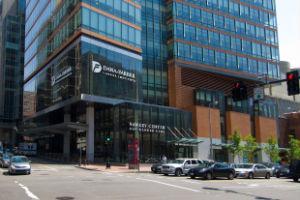
The urban complex of Dana-Farber Cancer Institute, in Boston, United States, is a representative of many current metropolitan care centers, with a main complex located in the congested center of a city that takes advantage of every available square meter.
New construction replaces existing structures, current facilities are reconfigured, and as institutions grow, their surface area expands into surrounding suburbs, in an effort to serve a growing number of patients and an increasing volume of research needs.
Introduction
Internationally recognized for its unparalleled combination of clinical and research activities to provide the most advanced care to cancer patients — the institute is visited by more than 300,000 patients a year and conducts approximately 700 clinical trials— Dana-Farber's only constant is change. In addition to the four alternate campuses, located in and around Boston, and the main clinical complex, located in the Longwood Medical Area, the institute also has medical affiliations and physical presence in other high-profile institutions, such as Brigham and Women's Hospital. Children's Hospital Boston and Harvard University, further expanding the scope of the institute.
When Dana-Farber undertook its most significant expansion project to date, the design and construction of the institute's new Yawkey Center for Patient Care, the work included the demolition of two buildings and an uncovered parking lot at its Boston headquarters. in order to make room for the new 14-story building.
The new Yawkey Center, which radically expanded the space available for clinical care provided by the institute, has more than 100 examination rooms, 150 infusion rooms and 20 consultation rooms. Built with the philosophy of unifying spaces for clinical care with the research functions associated with it, the institute promotes collaboration and the exchange of information on the different types and treatments of cancer.
Challenges
During the three years of construction, the staff in charge of security and management of the facilities had to assess the impact that the new and state-of-the-art facility would have on the institute's existing multi-site infrastructure.
Not only did the Yawkey Center add 275,000 square feet (25,5475 square meters) of space for clinical support and care to the institute's overall footprint, but security plans for the center included the addition of approximately 200 IP cameras that had to fit perfectly and efficiently into dana-Farber's considerable investment in its current CCTV surveillance equipment.
With 23 Intellex digital VCR from American Dynamics and approximately 300 analog cameras already installed at their facility, Dana-Farber's security staff was looking for a solution that would allow their security command center controllers to have a single interface through which they could view recorded and live video footage. captured by both analog cameras and IP cameras.
"Putting two separate systems in place for our security monitoring activities, one for IP video and one for analog video, was not a valid alternative for us," said Ralph Nerette, security manager at Dana-Farber Cancer Institute. "We had to choose a solution where we could seamlessly train our drivers and have them use it efficiently, regardless of whether the video came from digital video recorders (DVRs) or network video recorders (NVRs)."
To make this search even more complex, there were a number of additional responsibilities that Nerette's security personnel were about to take on. As part of a global renovation and upgrade project, the facilities' centralized maintenance, cleaning, and health and environmental safety functions were to become part of the security operations.
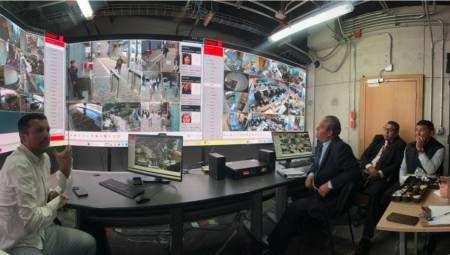
This facility, called the Institute's Facility Security Operation Center (FSOC), would manage two million square feet (185,800 square meters) of space dedicated to Dana-Farber's clinical, research and administrative activities and a call volume that sometimes exceeded 1,000 communications per day. requiring, therefore, considerably larger infrastructure than the current 120-square-foot (11,148-square-meter) security command center could handle.
"We needed much more functional space and the ability to segment equipment, reduce noise and allow our controllers to focus on customers and providing the level of service required by a safety operation of this magnitude," Nerette said.
Solution
With such a huge operational network of Intellex digital VCR, Nerette and its employees worked with system integrators, Tesla Systems, of Georgetown, Massachusetts, and Team AVS of Westford, Massachusetts, to find a video management system (VMS) that would allow digital VCR to be used in conjunction with the new IP cameras and network video recorders. and that, likewise, it would function as a future platform, when the institute, at some point, would take the step to a solution based entirely on IP.
Using American Dynamics' new unified video management system, victor, and VideoEdge network video recorder, all analog and IP video streams and Intellex digital VCR from Dana-Farber's 500 cameras are seamlessly integrated into victor's unique system and user interface.
Instead of jumping between different applications on their monitors, controllers can only care about the content of the video and fulfilling their usual duties of ensuring the safety of hospital facilities and not about what recording technology the video is generating.
"This solution allowed the institute to extend the life of the Intellex cameras we already had," Nerette said. "Instead of dismantling and replacing, we were able to channel our new investments in state-of-the-art IP technology as part of the Yawkey expansion. This allowed us to strategically add IP cameras in other key areas and save money," said Nerette.
The video originated by The Yawkey Center's 200 new IP cameras and other camera groups – such as the set of 22 IP cameras deployed in one of the most sensitive research areas – is recorded on four VideoEdge network video recorders, of American Dynamics. Additionally, there are two network video recorders to, in case of failure, guarantee uninterrupted operation. On average, Dana-Farber will be storing 30 days of video per camera on the institute's 70TB external iSCSI storage.
According to Robert O'Rourke, an account executive at Tesla Systems, because controllers display approximately 60 cameras at a time, these unified operations are vital to the command center workflow.
"One of the biggest challenges of this project was to integrate analog video and IP video technologies to make them work in seamless integration," O'Rourke said. "The command center has two 42-inch monitors and 14 additional 20-inch screens, with video coming from five remote locations, which increased the complexity of this project."
Another fundamental condition that the system had to meet was the possibility of easily sharing video with other users within Dana-Farber, preventing, however, unauthorized views and exports of the material. Thanks to victor's built-in policy management features, Nerette can ensure secure access for other users to the CCTV system – apart from users in the security and maintenance departments of the facilities – to view specific sequences, whether live or recorded video, only from other areas of the facilities, coming from previously designated cameras. Thanks to the deployment of such a function of the victor video management system, these groups of people also cannot export any video material.
Very soon, the security personnel of the institute's command center will have one less system to monitor. According to Geva Barash, President of Team AVS, thanks to an update of Software House's C•CURE 9000 security monitoring platform, scheduled for next year, Dana-Farber will be able to use the 2012 version of victor as a unified security and event management platform, to integrate card access functions, as well as fire protection and other building management functions.
For Dana-Farber staff it is clear that undertaking the installation of a new command center, built based on the victor platform, which takes full advantage of the strength of the video infrastructure that Dana-Farber had and the flexibility of IP video, has made it possible to achieve two fundamental goals.
Not only has it allowed the institute to have custom-designed clinical facilities to further strengthen its mission of excellence in cancer care and research, but also a modern infrastructure in which to locate security operations and facilities management in the future.
* Tyco Security Products, a business unit of Tyco International, is a unified group of the world's leading brands in access control, video and intrusion detection. Operating in more than 40 offices and more than 2,500 employees, Tyco Security Products' brands — American Dynamics, Bentel, CEM Systems, CONNECT24, DSC, Kantech, Software House, Sur-Gard and Visonic.