Under the open arms of Christ the Redeemer, and the security system implemented in the Court of Justice of the state of Rio de Janeiro and its surroundings, the judges, inhabitants and visitors of this Brazilian state are monitored and protected 24 hours a day, seven days a week.
 by Ana María Restrepo
76 years ago, christ the Redeemer was erected on the hill of Corcovado, (one of the new 7 wonders of the world) located in Rio de Janeiro, one of the most beautiful and important cities in Brazil.
Rio de Enero (Spanish translation of Rio de Janeiro), discovered by the Portuguese navigator Gaspar de Lemos in 1502, has a subtropical climate, with average temperatures and varied attractions that have given it international fame such as the beaches of Ipanema and Copacabana, the Tijuca National Park (the largest nature reserve in an urban region of the country), the Maracanã Stadium, the Rio Carnival and the museums and ecotourism venues.
It should be noted that from 1764 the city was the seat of the Federal Government until 1960, when Brasilia (current capital of the country) was inaugurated. As a result of this, the streets of Rio are characterized by sumptuous and imposing constructions that reflect the powerful and bourgeois past of those times.
The city of Rio de Janeiro is also famous for its geographical and urban features, as it is located in an area limited by the ocean and the mountains. Additionally, it has a population density of 5155.8 inhabitants/km², since between 2005 and 2006 it had 14,381,282 inhabitants according to the virtual encyclopedia Wikipedia.
The state of Rio has two airports, the international airport, Antônio Carlos Jobim 20 km from the center that receives flights from the main cities of Brazil and the world, and the Santos Dumont airport, located in Guanabara Bay and close to the center, which works only for small flights. Due to its good climate, Rio receives year-round visitors from the country and the world.
Rio de Janeiro, an autonomous state
In Brazil, states are autonomous entities organized with branches of administration, relative financial independence and their own symbols similar to those of a nation; however, they maintain the same model of national administration imposed by the constitution.
In each state, the Executive branch is made up of the Governor and his secretaries, the Legislative branch by the Legislative Assembly and the Judicial branch is constituted by the Court of Justice.
Similarly, in this Latin American country cities and towns are not differentiated by one word, moreover, the Portuguese word cidade covers both denominations. However, if there are two possible differences between these municipalities: the first is that those that have a Court of Justice are called 'Sedes de Comarca' (Comarca is the territory according to the rule of that Court) and the second is the size and importance.
As important features, a municipality is allowed to have its own organic law and municipal police, collect taxes and fees, and pass laws that do not contradict the national constitution, in addition to having a flag, anthem and coat of arms, an elected Mayor and a Chamber of Councilors.
It should be noted that Brazil had, until 1974, a state-type municipality, the State of Guanabara, which combined with Rio de Janeiro comprised the city that bears the same name.
Judicial power
In the organization of the Brazilian state, the Federal Constitution confers the power to apply legal norms exclusively by the courts of justice. In the case of the state of Rio de Janeiro, the Court of Justice assumes the resolution of conflicts of interest according to their nature for the democratic exercise of citizenship.
However, the practice of the profession within this state body has brought serious consequences to judges and their families. Following the assassination of two judges some years ago, this judicial body needed the implementation of a security mechanism between 2003 and 2004.
"This situation of insecurity was also experienced at the national level, where there were continuous attacks on police stations, barracks and state buildings, especially in the states of Sao Paulo and Rio de Janeiro," said Francisco Matias, director of the cabinet of the General Directorate of Security of the Court of Justice of the State of Rio de Janeiro. and Renato Oliveira, director of the Tribunal's telecommunications security projects department.
Faced with the need to restore the tranquility of the members of the Tribunal and its visitors, and increase the security of the institution, a series of preventive actions and an action plan were created that included the old security system, which consisted of a video matrix of 64 cameras of black and white images and of low quality, which were displayed on four analog 14" monitors connected to four recorders. Additionally, each camera had a motion sensor that allowed intrusion detection. The recording of the images was done on Time Lapse equipment with VHS tapes that had to be replaced every 12 hours. According to Matias and Oliveira, the work of the image investigation was inaccurate and delayed, since several tapes had to be handled, something that has been overcome thanks to the new digital systems that the institution has today.
Access control to the complex
Likewise, the Court of Justice of the state of Rio de Janeiro presented a difficulty in terms of the high flow of people (approximately 60,000 daily), and its access control to the Court complex, consisting of four buildings, two of four and five floors and two others that have eleven and thirteen floors.
Due to the problem of coordinating admission to the Tribunal and the incidents that occurred years ago, the Department of Projects and Telecommunications Security and the General Directorate of Institutional Security of the Tribunal, developed a new surveillance project that would meet both the need for protection and control of access to this property for public use.
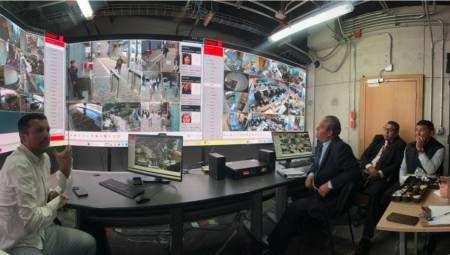
The project was marked by the main concept of massive electronic monitoring through a CCTV, and the location of cameras in all accesses and internal and external common areas. In addition, this system had to have electronic ratchets for employee access through identification cards and reading by approximation; metal detectors at entrances for the general public; X-ray scanner on the sides of metal detectors; control and command center of all electronic security activities (Cengeg); radio network integrated into the PBX and an alarm system.
In the other facilities of the entity, metal detectors were also required for the entrances; ccTV control centre; radios for the police and alarm system with report in different places such as police stations, battalion of the military police of the area and the Cengeg.
Watched by thousands of electronic eyes
For the implementation of this project, the directors of these departments defined some basic characteristics for the choice of the installation company of the system, within which they took into account that it was a work team worthy of trust and that it was positioned in the market; they also wanted to find high-efficiency digital equipment, of the same brand, and with 30-day image storage capacity; technical support and training of the workforce for the execution of maintenance; in addition to a good guarantee of both the parts and the materials.
Under the premise of these requirements, the new CCTV was installed in the Palace of Justice complex and in 53 other organizational units between forums and courts, located throughout the state of Rio de Janeiro. This system consists of 904 chambers arranged in the other organizations and 344 chambers within the Court complex, distributed in the four existing buildings and in the historic construction of the Court of Criminal Appeal. There is also a 'panic' alarm system, which allows judges to report any emergency they have through a pedal and a button, which send the signal to the control center. It should be noted that the protection and supervision of all cameras and alarms are carried out from the Cengec.
The Tribunal's surveillance system is carried out seven days a week 24 hours a day through 321 fixed cameras and 23 Samsung high-speed domes. The images are stored in 12 DVR's Digital WatchDog for approximately 60 days. In the other institutions monitored, 53 Samsung GVI boards and 904 cameras linked to the control and command center, Cengec, are used. Matias and Oliveira also explain that the security monitoring system is carried out to live and live images randomly or by request received by phone or radio.
It is important to note that the new systems did not present any difficulties for their implementation due to the help provided by the chosen company.
Systems that provide security and peace of mind
For the director of the Department of Projects and Telecommunications Security as well as for the head of the General Directorate of Institutional Security of the Court, this new security system has as its main objective to prevent situations that may put in imminent danger the physical integrity of people and the risk of damage to public property.
The new protection system has brought excellent results over the years for the Court of Justice of the state of Rio de Janeiro, and has met the needs of security and tranquility of those who work in the complex and all those around it, because the implemented control copes with almost all security requests, controls access and monitors each space.
As results obtained after the new implementation in security, Oliveira and Matias highlight the significant reduction of almost 90% of the number of occurrences such as robberies and small acts of vandalism, detection of suspects both inside and outside the complex and capture of thieves in the corridors. This surveillance system has also supported public security agencies in reducing crimes committed in the vicinity of the Tribunal.
The surveillance system and relentless monitoring of the complex's cameras made it possible to record the moments when two women were attacked by thieves in downtown Rio de Janeiro, allowing police to arrest them and recover the stolen items. Similarly, in 2005 the Ministry of Public Security installed cameras in the center of the city, in some neighborhoods and in some of its main avenues.
Fun, technology and safety
Today, security in Rio de Janeiro continues to be a matter of concern and discussion among the inhabitants and rulers of the state, as the city is considered one of the localities with the highest crime rates in the country, however the security measures that have been taken support police action and the decrease in crime rates. number of criminal events.
It should be noted that in recent days the capital of Rio de Janeiro hosted the XV version of the Pan American Games, an event that attracted athletes, journalists and tourists from various countries, who enjoyed the event and the city under high security conditions, which included police surveillance and intelligence and communication solutions that contained voice, data, video and images.
Likewise, the protection system implemented for this event was integrated with the surveillance cameras existing in the city for several years and with the emergency care systems of the police and firefighters.
According to data collected by the newspaper El País of Colombia, after the Pan American Games and the security system implemented for them, currently the police of Rio de Janeiro have an intelligence system that allows to detect illegal actions and provide the inhabitants and visitors of the city with the tranquility and security they demand.